


Just received my first payment — £280 direct to my account. No escrow, no waiting. The client approved my AI workflow automation deliverable this morning. This is real.
🔥 47
💬 12 comments

In one most engaging study, Helseth (1926) followed for the whole year an eighth-grade class where the teacher ‘threw all of her teaching power’ into getting the pupils to ask questions. ‘In September they sat passive… In May the pupils themselves introduced the problems on which they desired help in solving’ (Helseth 1926: 74). -Dillon, 1988
Questioning is an important aspect of everyday educational experience. For increasing our awareness and understanding of this essential teaching and learning component, we introduce a 2-part mini-series discussing how we, as teachers, can address it in the classroom.
In the first part of this mini-series about questioning, we focused on the critical role of questioning in the context of education and how we, as teachers, can uplift it. The second installment addresses specific questions that find their best fit within the Approaches to Teaching and Learning (ATLs) instructional framework, which was proposed by the International Baccalaureate Organization (IBO, 2015).
ATLs develop in six strands regarding teaching, and five in reference to learning; they can work separately or they can be mixed and matched. Approaches to Teaching suggest ways in which the educator can unfold their instruction to achieve a variety of goals, such as inquiry, conceptual understanding, local-global contexts, teamwork, differentiation, and assessment. Simultaneously, with Approaches to Learning, students improve their skills in research, thinking, communication, socialization, and self-management.
When following an instruction informed by ATLs, you can deal with questioning in ways that will support your Approaches. You can aim to start with basic information questions and gradually move towards wonderment questions that demonstrate more elaborate inquiry. You set the pace and then facilitate so your students follow your lead.
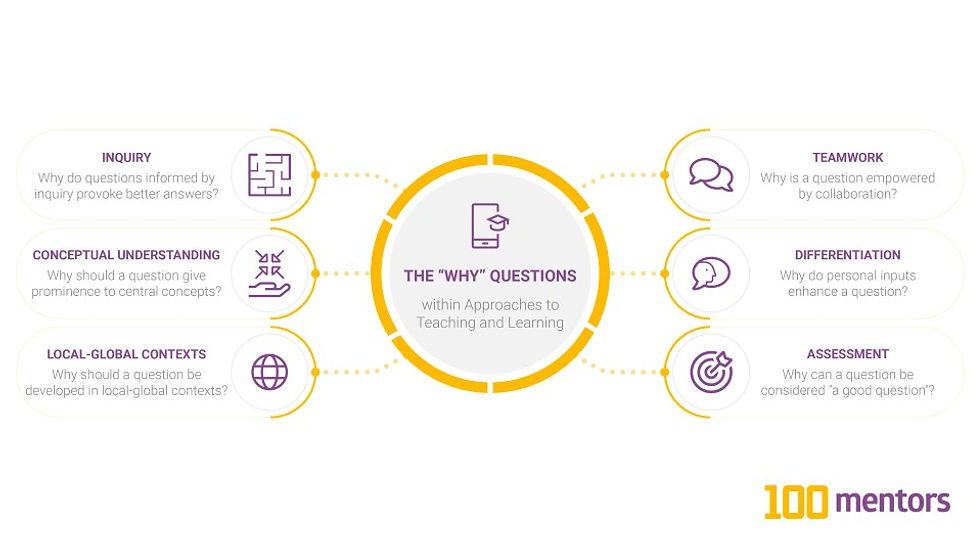
Each ATL can offer unique benefits for improving questioning in the classroom. Here’s how:
Why do questions informed by inquiry provoke better answers?
From school projects to scientific publications, we can find curious people that become inquirers to satisfy their thirst for knowledge. Those inquirers start to blossom in your classroom. Regardless if it is just a search for a piece of missing information or the development of a longitudinal study, we link inquiry to research. Research is a road that drives us from one place to another – when done properly and with a reasonable amount of enthusiasm. We stumble on resources that are useful and thought-provoking, but we also find things that are irrelevant; telling them apart is one of the most important research skills one can cultivate.
Taking this research-road and encountering all its challenges – with rewards and disappointments – gives us full control over our inquiry. Basic information questions are answered during the first stages of research, so we are left with wonderment questions: issues that are debatable or have not been answered yet.
The fun part of inquiry is that it suggests a circle: the person who attempts to answer our wonderment question may be challenged enough to conduct their own research. Teachers and students can either be the inquirers or those who provide answers – more ideally, they constantly change roles.
Why should a question give prominence to central concepts?
General ideas about our world are the first pieces of knowledge we gather and the easiest to project. They help us gradually familiarize ourselves with a variety of objects and events. So, in a way, they refer to basic information and the impetuous connections they make. Asking questions that relate to general ideas around a subject reflects that you are still familiarizing yourself with it or that you are trying to attract novice learners into this realm.
Advancement of thinking skills is a prerequisite for going from the expression of general ideas to the discussion of concepts. Concepts are broad and powerful abstract notions. To form such notions, general ideas should be linked in a meaningful way within and across different fields. A question that refers to concepts, or calls for an answer that involves concepts, is a sign for adequate conceptual understanding.
Concept-focused questioning can facilitate connecting general ideas successfully enough to move towards concepts, whether you are setting the question or providing the answer. It calls both parties to rise up to the challenge: give width to their perspectives and depth to their approaches. To more efficiently handle this process, setting a specific topic can substantially help all participants to stay on the right inquiry track.
Why should a question be developed in both local and global contexts?
We are part of a universal society that communicates at the speed of light – literally. International-mindedness should affect our questions and act as a filter for the answers we receive. Significant and fascinating things that happen in global contexts can shape our perspective. Plus, cultural diversity needs to be taken into consideration to get the most out of our communication with others.
However, we mainly set questions based on our personal experience. Real-life situations that we have encountered affect us to a great extent and have a tremendous impact on the formation of our inquiries. These viewpoints are additionally influenced by some local contexts within our reaches, such as our family, our community, or even our country.
Personal and local contexts shouldn’t be dismissed, they should be celebrated: it’s important to acknowledge and unpack the frames of reference students are familiar with and reflect their own culture. But posing questions considering local frameworks alone provokes respective answers: the person who responds is implicitly prompt to address these restricted contexts. Teachers can set the pace by asking all-inclusive contexts questions; students would go from local to global and the other way around, broadening their perspectives.
Why is a question empowered by collaboration?
It is widely accepted that “two minds are better than one.” When it comes to inquiry, I prefer to enhance this saying with another: “the whole is greater than the sum of its parts.” This is the result of efficient collaboration; after all, there should be a good reason why people working in teams is the current trend towards great discoveries
While conducting research and forming questions, teamwork creates interesting interactions. A student’s question doesn’t have to be addressed directly to the teacher, because a teammate can be ready to answer it. Basic information questions can be tackled first within the team, then wonderment questions can gather different interest viewpoints. The research deepens through this immediate feedback, and new questions arise.
As soon as the team finds an obstacle that can’t overcome with their own resources, they require the teacher’s help. At this point, each student has individually found questions and answers, and, through collaboration, they have created a new question that integrates the outcomes of their entire interaction as a team. Therefore the team’s tip-of-the-iceberg question that reaches the teacher can be expected to be way more intriguing than each student’s question separately.
Why do personal inputs enhance a question?
We often think that a “proper” question is formed in a passive voice and successfully hides any personal leads. Although this is a common strategy in the realms of academia, it’s not mandatory for school education. Students are in a constant state of personal discovery, and we should allow their questions to reflect their unique perspectives.
Any given subject can challenge our curiosity and wonderment, but we don’t all have the same starting point, nor do we process new information in the same manner. Differentiation in learning should start with questions: demonstrating personal experience and prior knowledge is key in forming a precise and meaningful question.
Students showing in a straight-forward way what they have in mind and what their capabilities are, without modest expressions and generalizations, can allow teachers to give answers that truly address students’ problems and doubts. Receiving acceptance for their individuality encourages them to proceed with their learning journey and reach their full potential.
A final ATL refers to teaching informed by assessment and the fostering of student self-management skills. When it comes to questioning, this Approach should reflect on all the rest that have been listed above. Don’t get me wrong – questioning and assessment aren’t just two sides of the same coin.
In this case, we should assess the question itself, and can students do the same for their own questions and their classmates’ questions. The goal is not to grade or pass judgments; it’s to define the positive and counteractive characteristics that have shaped the question and, consequently, affect the quality of the expected answer.
So, how can we bring all this meaningful questioning in our classroom and serve our Approaches to Teaching and Learning at the same time? Ideally, with the use of educational technology that facilitates teachers in achieving their goals and responds to students’ thirst for innovation. It is the perfect opportunity to try a tool that focuses explicitly on receiving questions and providing answers.
Oh, yes – let’s not forget about the answers. Students posing questions is a big deal, but they show expectancy of something: mind-blowing, thought-provoking answers. In most cases, we can provide them just fine, but they should have the chance to be acquainted with multiple perspectives beyond their teachers’ and classmates’. Mentorship can give them the privilege of having their questions answered by experts in industries and academia in their respective fields.
You can meet your ATL goals and support questioning in the classroom with 100mentors, today.

Sources
Dillon, J. T. (1988). The remedial status of student questioning. Journal of Curriculum Studies, 20(3), 197–210.
Helseth, I.O. (1926). Children’s thinking. A study of the thinking done by a group of grade children when encouraged to ask questions about United States history. Columbia Univ. Contrib. to Educ.: New York.
IBO. (2015). Approaches to teaching and learning. Retrieved December 2, 2019, from https://xmltwo.ibo.org/publications/DP/Group0/d_0_dpatl_gui_1502_1/static/dpatl/
These are your future squad members. They are already inside the Sprint — building, delivering, and getting paid.
489 members · Public Group · WorkTravel Academy
Just received my first payment — £280 direct to my account. No escrow, no waiting. The client approved my AI workflow automation deliverable this morning. This is real.
Blockchain credential issued. Week 4 complete. My SkillBridge AI profile now shows 2 verified deliverables. Already been matched to a second project — starting Monday.
Squad Lead reviewed my first submission. Feedback was specific and actually useful — not generic. Already know exactly what to fix for Week 2. This is the mentorship I couldn't find anywhere else.
Applied to 50+ jobs last year. Zero responses. Joined the Sprint 4 weeks ago. Now I have 2 paid deliverables, a blockchain credential, and a second project offer. The CV is dead. Proof is everything.
They were exactly where you are now — skilled, invisible, frustrated.
They chose to build proof instead of sending more CVs.
Free for qualified members · 10–20 hrs/week · Results in 4 weeks
Your brief becomes a live, SEO-optimised project page on WorkTravel.Agency — proof of your work, not just a claim.
We've received your brief and will send your live project page link to your email within 24 hours.
Your project will appear at:
worktravel.agency/projects/[your-location]
Your Group is your project landing page. It's where your squad collaborates, where Sponsors discover you, and where you earn your first Academy Credits. Create it now — it takes 2 minutes.
+ Create Your Project GroupAlready have a group? Browse all groups
Access 45+ podcast episodes and 100+ project-based learning videos. Every completed lesson earns you Academy Credits toward your next tier.
45 episodes covering AI operations, remote work strategy, and enterprise AI adoption. Real conversations with practitioners.
45 EpisodesShort, practical videos on AI operator skills. Perfect for building your AI toolkit step by step.
100+ VideosThis 5-minute episode is the fastest way to understand what WorkTravel Academy is about and why project-based AI learning beats certificates every time.
Watch the Podcast →From free Explorer to full White Label Partner — every tier includes Academy Credits, community access, and a verifiable AI project portfolio. All plans include the MiniMax Bonus System.
| Feature | Explorer | Builder | Verified | Squad Lead |
|---|---|---|---|---|
| Monthly Academy Credits | 100 (join) | 500 | 1,000 (once) | 2,000 |
| Community Access | ✓ | ✓ | ✓ | ✓ |
| Project-Based Learning Tracks | — | ✓ | ✓ | ✓ |
| Verifiable Portfolio Badge | — | ✓ | ✓ | ✓ |
| Official Verified Status | — | — | ✓ | ✓ |
| Enterprise Tool Discounts | — | ✓ | ✓ | ✓ |
| MiniMax Bonus System | Basic | Full | Full | Full + Mentor |
| Referral Commission | — | ✓ | ✓ | ✓ + Override |
| Enterprise Affiliation Bonus | — | — | — | ✓ |
| Mentor Revenue Share | — | — | — | ✓ |
| Sponsor Directory Listing | — | — | Priority | Featured |
| Price | Free | $7/mo | $99 once | $99/mo |
As a Squad Lead or Verified member, you can earn recurring commissions by recommending the enterprise tools your team already uses. Every referral earns you Academy Credits and real cash commissions — paid directly by our partners.
The Enterprise Affiliation Bonus Track is available to Squad Lead and Verified members.
Choose from our vetted list of enterprise AI and automation platforms.
Use your unique referral link in your project groups, blog posts, and client proposals.
Earn Academy Credits for every referral, plus direct commissions from the partner platform.
The Enterprise Affiliation Bonus Track is available to members on the Squad Lead plan ($99/month) or those who have achieved Verified status ($99 one-time). Upgrade today to unlock your referral links and start earning recurring commissions from the tools you already recommend.
Upgrade to Squad Lead →Understand how Credits, Projects, and the Bonus System work together.
Comments